


Helicobacter Screening
Exhalation test for Helicobacter pylori
The method is based on the measurement of exhaled 14C-carbon dioxide produced from 14C-labelled urea degraded by the enzyme urease within 15 minutes in situ.

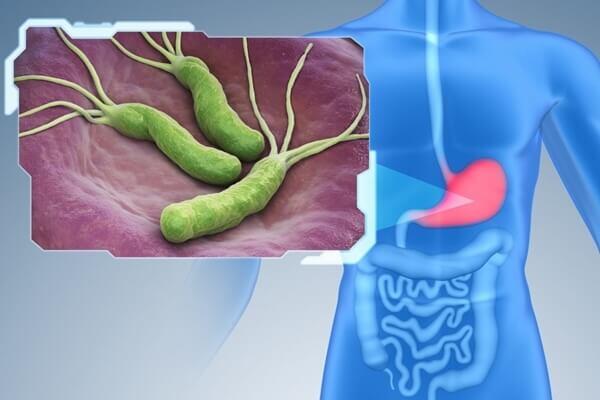
The aim of the test is to detect or exclude the presence of Helicobacter pylori, which causes stomach conditions. This bacterium is currently known to be responsible for the majority of duodenal and gastric ulcers and gastric tumours. If the presence of Helicobacter pylori bacteria is detected, medication may be considered, depending on the stomach symptoms.
Test procedure: the patient takes one capsule on an empty stomach. If Helicobacter pylori is present in the stomach, it breaks down the contents of the capsule. The degradation product is absorbed and excreted in the lungs after only 10 minutes. The patient then exhales into a small pouch (breath card) until the colour signal on the test changes (1-4 minutes). The breath card is then placed in the measuring device, which measures the isotopic activity of the exhaled breakdown product. Do not rebreathe the air from the bag!
The radiation exposure of the test is negligible, equivalent to the whole-body dose of a half-hour flight. The urea capsule contains a free-release amount of radioactivity.
The advantages of the method are that the test has a specificity and sensitivity of 98-100%, detects the Helicobacter pylori bacteria itself, and can be used to verify the effectiveness of eradication in a short time. The test filters out false positives and false negatives.
Időpontfoglalás
A csillaggal (*) jelölt részek kitöltése kötelező.